
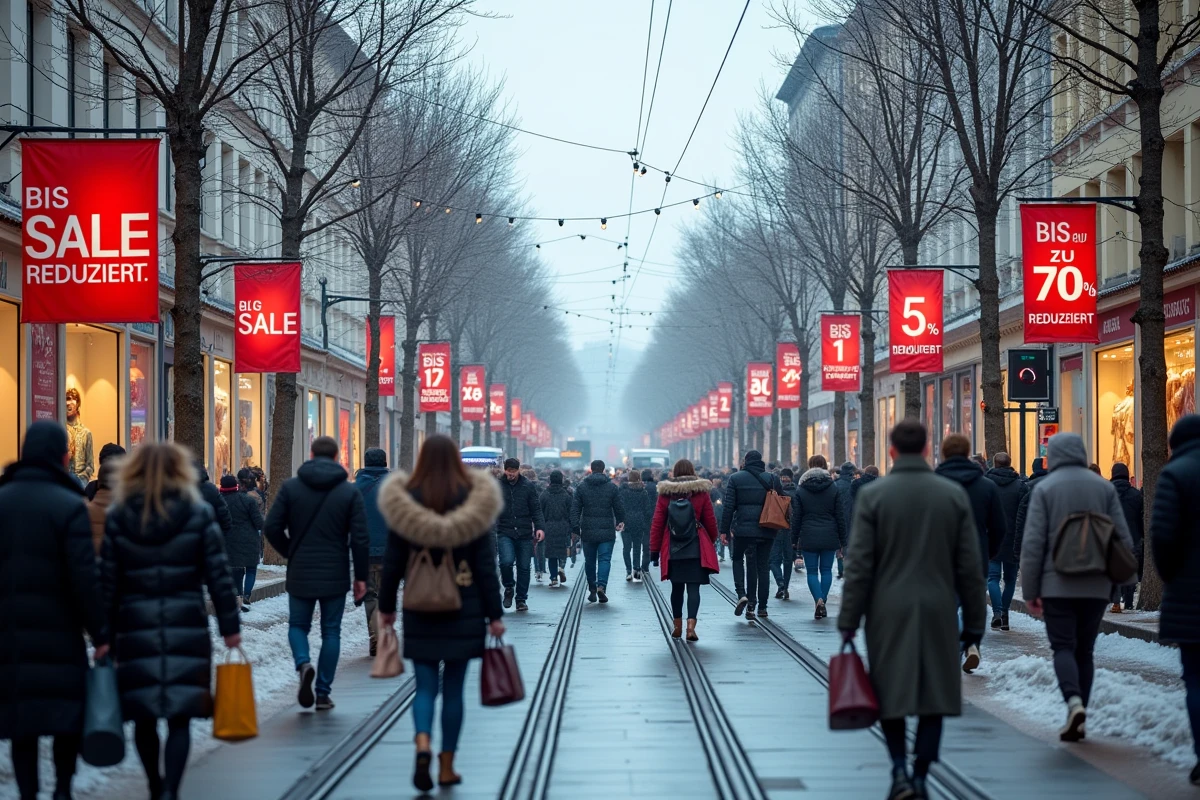
In Germany, regulated sales have not existed since 2004. Each retailer freely sets its discount periods, making the German promotional calendar difficult to read for a French consumer accustomed to fixed national dates. The traditional Winterschlussverkauf (winter sales) and Sommerschlussverkauf (summer sales) persist out of commercial habit, but without any binding legal framework.
This total freedom creates a commercial landscape where promotions overlap, where Black Week is gaining ground, and where the question of “the right time to buy” deserves to be rephrased. Instead of looking for a starting date, one must evaluate what remains truly advantageous once all parameters are taken into account.
Real cost of cross-border shopping in Germany: beyond the displayed discounts
The percentage of discount displayed in the window does not reflect the actual savings. The calculation that matters is the overall cost of the operation, especially for cross-border shoppers or those considering a trip from France.
The price of the trip (fuel, tolls, parking in downtown Munich or Berlin) can absorb a significant portion of the savings made on a piece of clothing or an electronic device. For border areas like Moselle or Alsace, geographical proximity reduces this additional cost, which explains why German retailers in these regions often align their promotions with the French sales calendar.
To find the dates of sales in Germany on Moderne Mode, it is important to keep in mind that these dates are indicative, with each store deciding autonomously.
Another factor rarely integrated: price transparency for 30 days is mandatory in the European Union since the Omnibus directive. German retailers must display the lowest price charged in the last 30 days before any announcement of a discount. This mechanism limits false promotions, but it also means that spectacular discounts (-50% or more) often apply to end-of-life references or excess stock.

Black Week and German sales: two competing logics
Black Week (the week surrounding Black Friday, usually at the end of November) has become a third highlight of the German commercial calendar, alongside winter and summer sales. This phenomenon is not trivial: Black Week tends to replace more scattered autumn promotions, particularly in electronics, fashion, and home appliances.
For the consumer, this changes the purchasing strategy. Waiting for winter sales (traditionally late January to mid-February) to buy a coat or a household appliance only makes sense if the targeted product has not already been discounted during Black Week, two months earlier. Some retailers reserve their best offers for Black Week, while others offer deeper discounts in January on unsold items.
What this changes for fashion products
Seasonal clothing (coats, boots, autumn-winter collections) undergoes a potential double markdown. Black Week attacks prices as early as late November. The Winterschlussverkauf, a few weeks later, sells off what remains. The choice of sizes and models is significantly wider in November than in January.
In contrast, summer items follow a more classic pattern. The Sommerschlussverkauf (scheduled around late July to mid-August) remains the main summer clearance moment, with no direct seasonal competitor comparable to Black Week.
Anticipating German promotions: newsletters and targeted monitoring
In the absence of an official calendar, the only reliable method to spot good deals relies on direct monitoring of retailers. Major German chains announce their operations one to two weeks before launch, primarily through their newsletters and social media.
This anticipation changes the nature of preparation. Instead of memorizing fixed dates, it is more effective to subscribe to communications from targeted stores. Here are the most useful channels:
- Retailers’ newsletters often allow access to pre-sales reserved for subscribers, with early access of 24 to 48 hours before public opening.
- Instagram and Facebook accounts of physical stores, especially in major cities like Munich, Berlin, or Hamburg, publish previews of upcoming discounts.
- Online price comparison sites (idealo.de being the most used in Germany) display price history, allowing verification of whether an announced discount is real compared to prices in previous weeks.
Sales in Germany and warranty: what European law protects
A product purchased on sale in Germany benefits from the same legal warranty of conformity as a full-price product. The legal warranty of conformity applies in all EU countries, regardless of the price paid or the “on sale” label.
For online purchases from a German seller, the 14-day right of withdrawal remains applicable. This period runs from the receipt of the package, not from the order. Available data does not allow concluding that returns are more complicated with German retailers than with French sellers, but return shipping costs remain the responsibility of the buyer unless otherwise stated in the general terms of sale.
In case of a dispute with a German seller
The European Consumer Centre (ECC) France-Germany handles cross-border complaints. This free service covers both online and in-store purchases. It is the first reflex to have before considering any heavier procedures.
The real calculation for a French buyer interested in German sales does not focus on the percentage displayed in the window. It focuses on the final price, including transport, related to product availability and warranty strength. The most interesting promotions often lie in the combination of a short trip (border areas), a targeted purchase prepared via newsletters, and a prior check of price history.