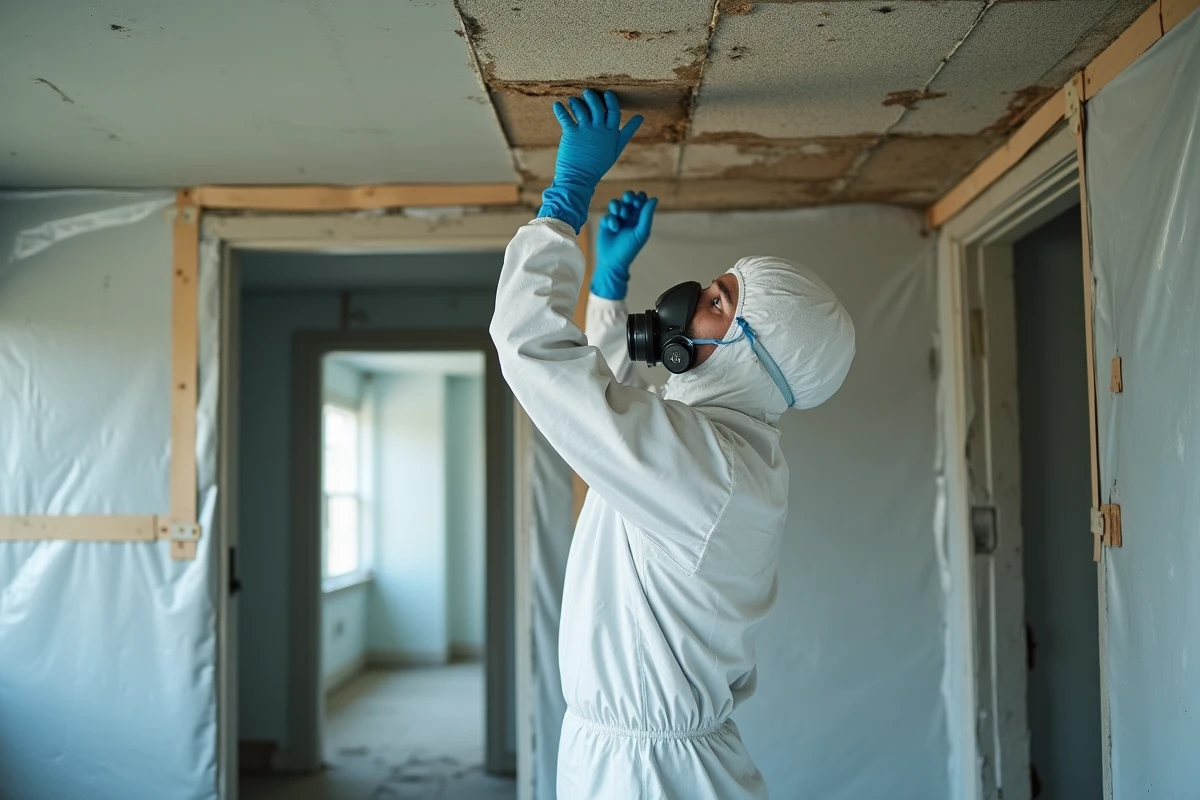
On a renovation site, drilling a false ceiling slab or sanding an old coating without prior verification is enough to release asbestos fibers into the ambient air. These microscopic particles remain suspended for a long time, settle on all surfaces, and pose a serious health risk, even at low concentrations. Eliminating asbestos dust is not just a matter of vacuuming: each step follows a strict protocol, and failing to comply exposes occupants and workers.
Final cleaning after asbestos removal: the phase that specifications underestimate
Most content on asbestos removal stops at the removal of asbestos-containing materials (ACM). The problem begins afterward. Residual dust trapped in tile joints, technical ducts, or corners of a false ceiling does not disappear with containment.
This is referred to as fine decontamination cleaning, a procedure distinct from simple removal. It employs HEPA-filter vacuums, capable of capturing asbestos fibers that are significantly smaller than a micron. The process is carried out in several cycles: complete vacuuming of horizontal and vertical surfaces, wet wiping, followed by another vacuuming.
Before the premises are put back into service, visual inspections and sometimes dust measurements in the air verify that the regulatory threshold is not exceeded. However, this protocol remains poorly known among private project owners who believe that the site is finished once the asbestos-cement sheets are removed.
To learn everything about asbestos dust, it is essential to understand that it is this final phase that determines whether a space is truly safe.
Asbestos identification before work: why even small sites are affected
It is often believed that asbestos diagnosis only concerns heavy demolitions or large buildings. Field reports show otherwise. Professional organizations like CAPEB now recommend never intervening, even for small residential renovation work, without reliable identification.
Removing a vinyl floor covering, taking down an old plaster, dismantling a lightweight partition: these common actions can release fibers if the material contains asbestos. Pre-work identification (RAT) involves having samples taken and analyzed by a certified diagnostician. The result conditions everything that follows: operating procedures, level of protection, waste management.
Increasingly strict sampling requirements
In Canada, for example, CNESST requires nine samples to confirm the absence of asbestos in a mixed heterogeneous material on site. This cautious approach reflects a general evolution: a single negative sample guarantees nothing if the material varies from one point to another. In France, regulations also impose a number of samples appropriate to the surface area and nature of the materials.
The reflex to adopt, whether one is a craftsman or an experienced DIYer, remains simple: do not scrape, drill, or sand before having a written diagnosis in hand.
Wet or dry decontamination: what works according to the surface
Two main approaches coexist to eliminate residual asbestos dust, and the choice depends directly on the type of surface to be treated.
- Wet decontamination uses misting or wiping with impregnated cloths. It lays the fibers down on the ground and limits their resuspension. This is the reference method for hard floors, painted walls, and smooth surfaces.
- Dry decontamination relies on HEPA vacuuming without prior wetting. It is suitable for porous or water-sensitive materials (insulation, certain plasters, electrical equipment) where moisture would cause further damage.
- In practice, both methods are often combined: dry vacuuming first to remove the bulk of the dust, then a wet pass to capture residual fibers, and finally a last HEPA vacuuming.
Feedback varies on this point depending on site configurations, but the combination of HEPA vacuuming followed by wet wiping remains the most reliable sequence in the majority of cases. The use of a conventional broom or household vacuum cleaner is strictly prohibited: these devices resuspend the fibers instead of capturing them.
Management of asbestos waste: packaging and regulated channels
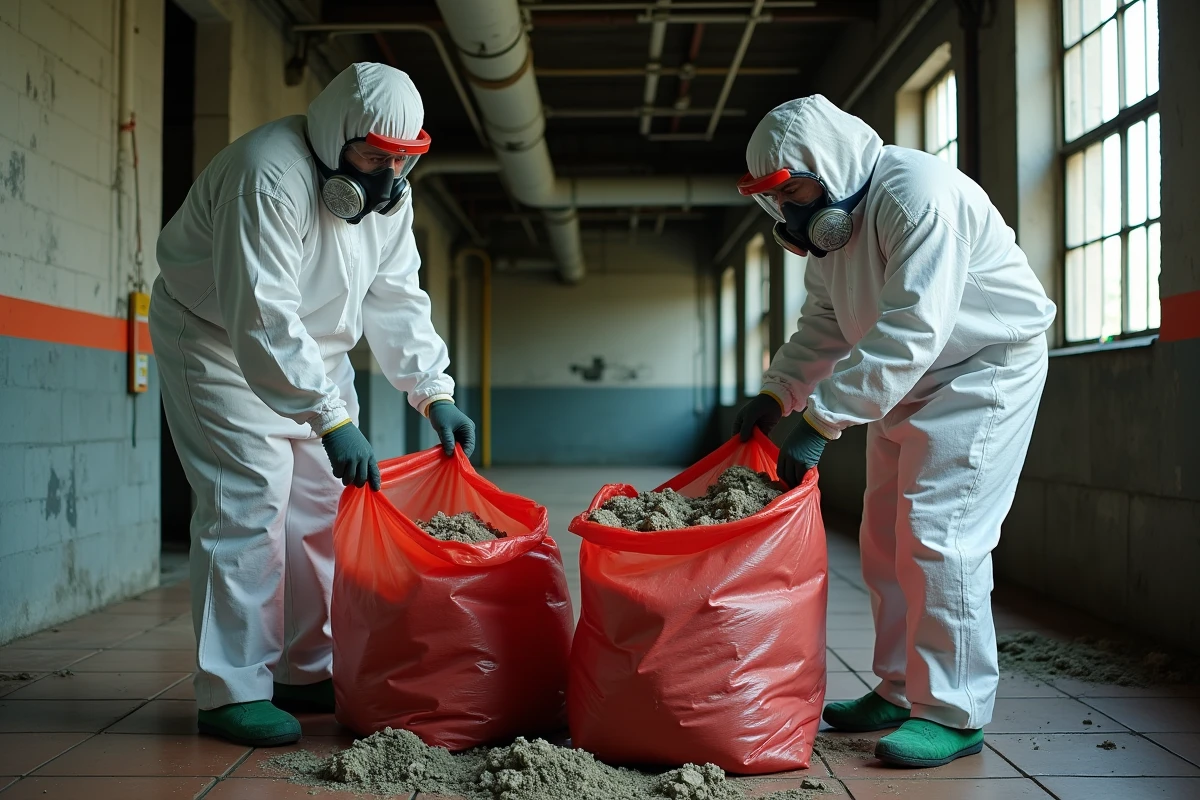
Once the materials are removed and the dust collected, the question of waste arises. Cleaning residues (used HEPA filters, cloths, containment tarps, disposable suits) are classified as asbestos waste just like the removed sheets or tiles.
On-site packaging
Each waste item is placed in double airtight packaging, usually specific colored “asbestos” bags, and sealed before any transport handling. No asbestos waste should pass through a regular skip or be mixed with other debris. The asbestos waste tracking slip (BSDA) accompanies each batch to the authorized storage facility.
In France, only hazardous waste storage facilities (ISDD) or vitrification channels accept these materials. The environmental code precisely regulates the conditions for transport, traceability, and disposal. The waste producer, often the asbestos removal company, remains responsible until acceptance at an approved center.
Personal protection on an asbestos site: the non-negotiable minimum
Site containment protects the external environment, but it is personal protective equipment (PPE) that protects the worker. On a site where ACM is handled or where residual dust is treated, the level of protection depends on the process implemented and the expected dust levels.
- Type 5/6 disposable suit, single-use, removed and packaged as asbestos waste after each intervention.
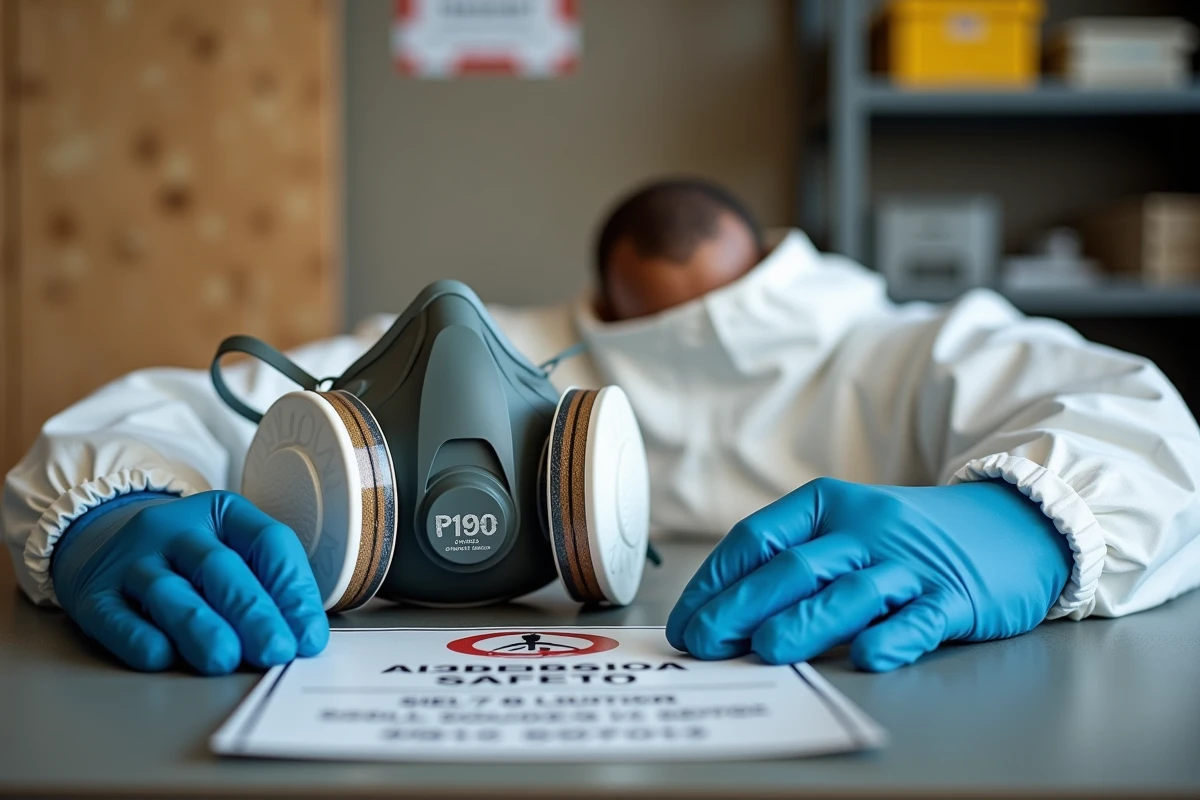
- Powered air-purifying respirator (PAPR) with P3 filter, or full mask with P3 cartridge for the lowest exposure levels.
- Gloves, shoe covers, and safety goggles, also single-use on high-risk sites.
The removal of PPE follows a precise undressing protocol to avoid any cross-contamination. The outer layer (suit, gloves) is removed first in the contaminated area, then one moves to the decontamination zone (hygiene shower) before removing the mask last.
Anyone working on an asbestos site, including for fine cleaning, must have undergone specific training. Regulations distinguish between operators of sub-section 3 (removal or encapsulation) and those of sub-section 4 (intervention on materials likely to release fibers during maintenance or repair work). Each level corresponds to training, medical monitoring, and exposure tracking obligations.
The risk associated with asbestos dust cannot be managed on a whim. From the initial diagnosis to the last HEPA vacuuming, each link in the chain conditions the actual safety of the building being returned to service. Neglecting fine cleaning or poorly packaging the waste amounts to shifting the problem instead of eliminating it.