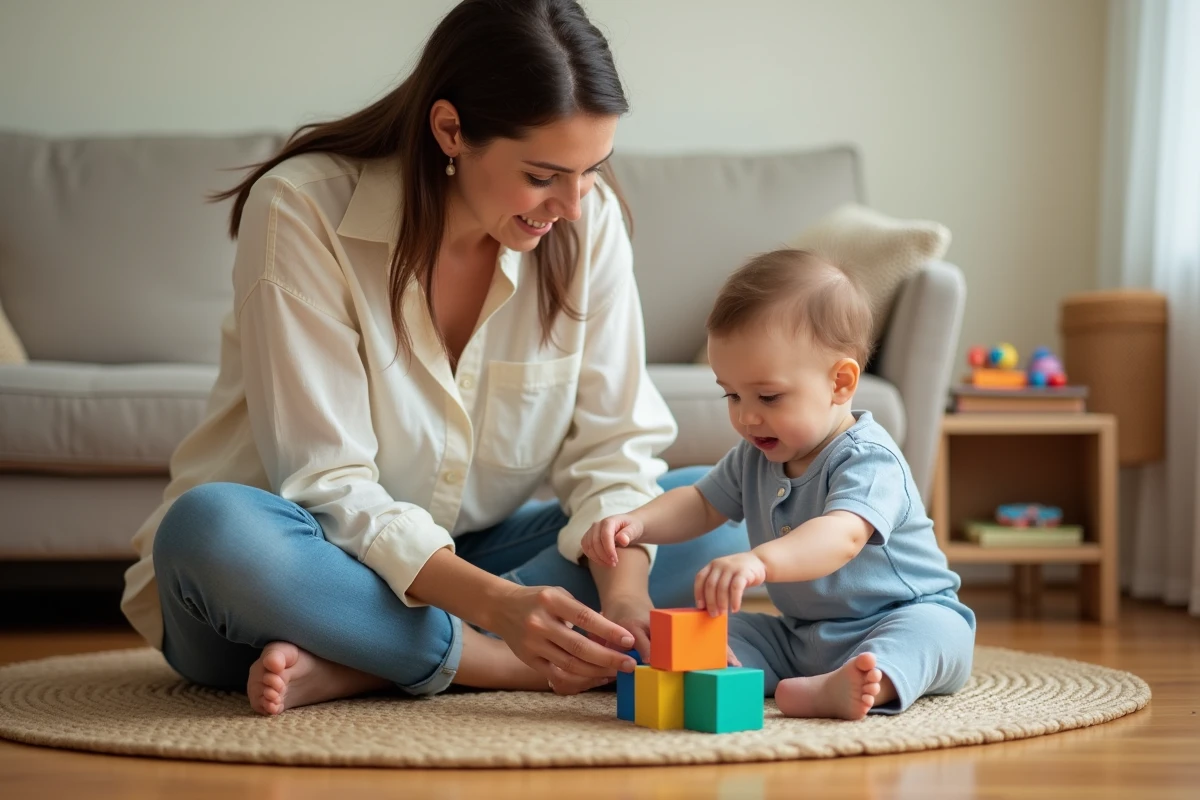
The development of a child relies on four spheres that progress in parallel: motor skills, cognition and language, affectivity, and socialization. These spheres do not function in isolation. A motor achievement (grabbing an object) triggers cognitive progress (understanding object permanence), which in turn nourishes language (naming the object). Supporting daily awakening means acting on these interactions rather than on each isolated skill.
Four spheres of child development and their concrete links
Gross motor skills (crawling, walking, climbing) and fine motor skills (grasping, stacking, drawing) form the foundation. A baby who starts to roll onto their stomach simultaneously works on their back muscles and spatial perception.
Cognitive and language development follows a parallel path. When a child manipulates a block and hears the word “block” spoken by an adult, two neural circuits strengthen at the same time. This coactivation explains why sensory activities (touching, tasting, smelling) have a measurable effect on vocabulary acquisition.
Affectivity and socialization form the third and fourth spheres. A child who feels emotionally secure explores their environment more, which feeds into their motor skills and cognition. The connection is circular, not linear.
To delve deeper into these topics by age group, you can visit the child page of Allo Papa which details each stage from early childhood to preadolescence.
Dialogic language from birth: why talk to a baby who doesn’t respond
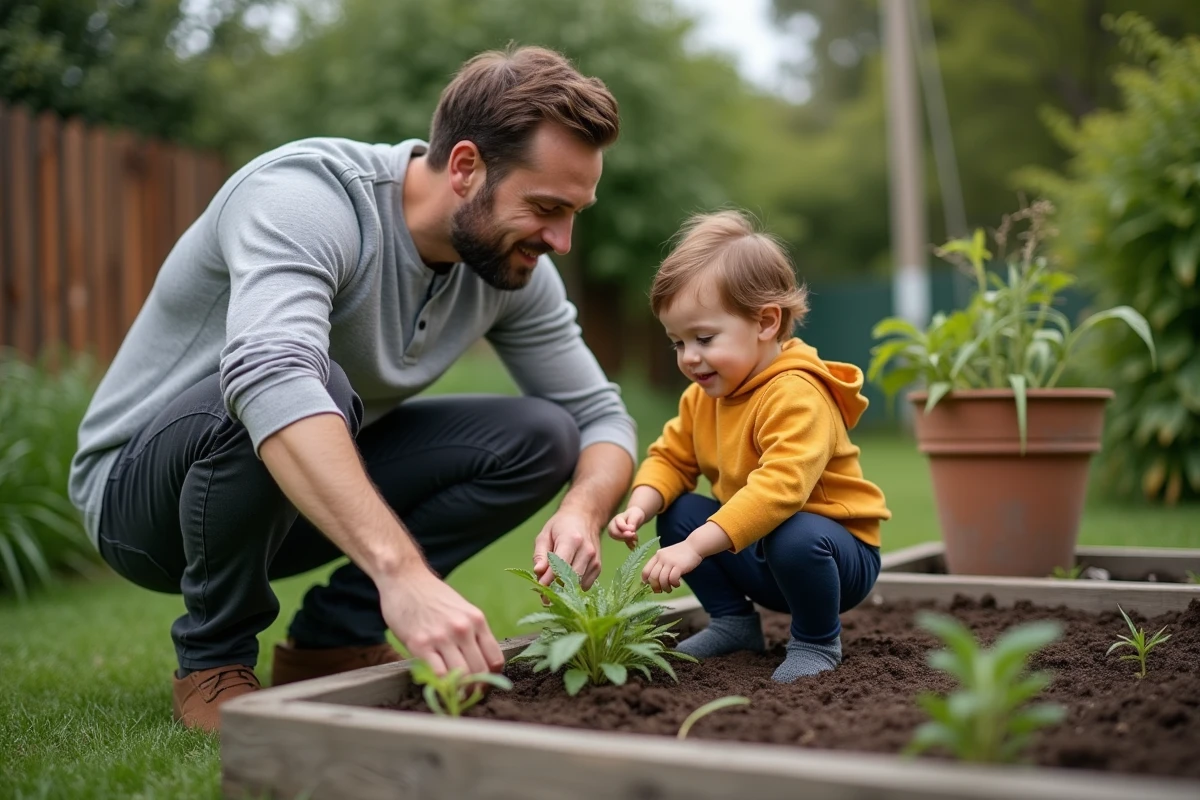
Dialogic language involves addressing the infant as if they were a conversational partner, allowing pauses after each sentence for them to react (look, move, coo). It is not a descriptive monologue. It is an asymmetrical exchange where the adult welcomes the baby’s non-verbal responses.
In France, the “First Steps” plan encourages reading from the cradle as part of public policies structured around this dialogic language. The goal is to reduce vocabulary gaps observed as early as kindergarten. Shared reading, even with a wordless book, works because it creates a framework for joint attention: the adult and child look at the same object, and the adult names what they see.
Three concrete practices reinforce this mechanism:
- Verbally describing daily actions (dressing, meals, bathing) using short sentences and varied vocabulary, without artificially simplifying the syntax.
- Allowing a silence of a few seconds after asking a question to the baby, even if they do not speak yet. This latency time stimulates attention and verbal planning circuits.
- Responding to the infant’s vocalizations by reformulating what they seem to express (“You are pointing to the cat, yes, that’s the cat”), which validates their attempt at communication.
This approach requires no materials. It demands regularity and a few minutes of attentive availability at a time.
Screens and young children’s awakening: what recent recommendations say
The WHO published guidelines in 2019 on physical activity, sedentary time, and sleep before age 5. The recommendation is clear: no screens before age 2. After age 2, screen time should remain limited and always accompanied by an adult.
The High Authority of Health has explicitly aligned itself with these recommendations in its 2023 work on early prevention and parenting support. A study published in JAMA Pediatrics in 2023 (data from the French Elfe cohort, by Madigan et al.) highlighted an association between screen time and developmental test outcomes in young children.
The problem is not just the content displayed. The screen replaces high developmental potential interactions: manipulating objects, verbal exchanges, free motor exploration. A child sitting in front of a tablet does not crawl, does not touch different textures, does not hear responses to their vocalizations.
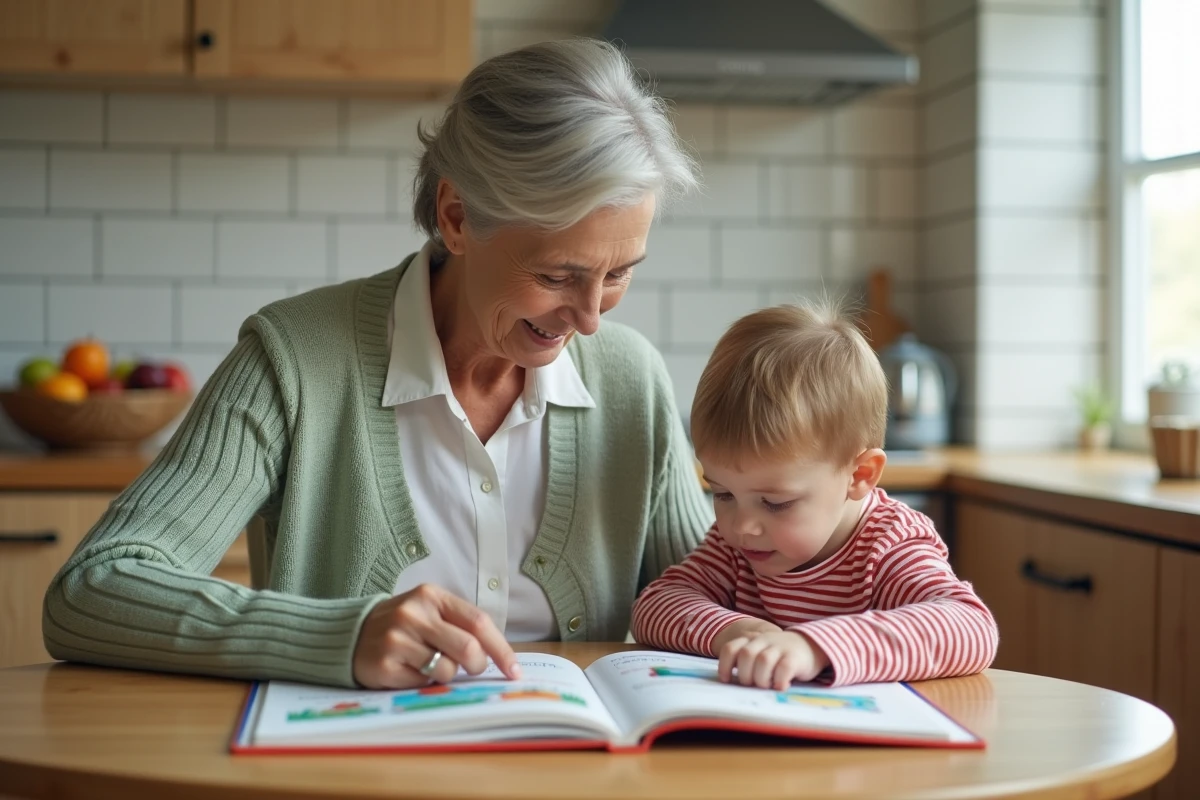
After age 2, a screen used with an adult who comments, questions, and pauses becomes one of many supports. The difference lies in the active presence of the adult, not in the nature of the content.
Free motor skills and awakening activities suitable for each age
Free motor skills are based on a simple principle: allowing the child to explore positions and movements at their own pace, without placing them in a posture they have not yet mastered independently. A baby placed sitting before they can sit up by themselves expends energy to maintain balance instead of exploring.
A secure and clear floor environment is sufficient for the first few months. A few objects of varied textures placed within reach encourage grasping and hand-eye coordination. Overstimulating play mats with sound and light often produce the opposite effect: sensory saturation that reduces autonomous exploration time.
As they grow, construction games, drawing, modeling clay, and water play simultaneously engage fine motor skills and problem-solving. The activity does not need to be labeled “educational” to be effective. A child helping to sort socks works on categorization, visual discrimination, and fine motor skills.
- Before walking: offer objects to grasp, pull, shake, of different weights and shapes. Vary surfaces (carpet, wood, grass) to stimulate support.
- Between ages 1 and 3: prioritize activities that involve the whole body (climbing on a cushion, pushing a cart, transferring water) and pretend play that nurtures affectivity.
- After age 3: introduce simple rule games (bingo, memory) that develop working memory, waiting for their turn, and managing frustration.
The pace of each child remains the main guide. A delay compared to a reference grid is not necessarily a warning signal, but a persistent gap across multiple spheres justifies medical advice. Regularly observing and noting progress allows for spotting these gaps without falling into anxiety-inducing comparisons with other children of the same age.