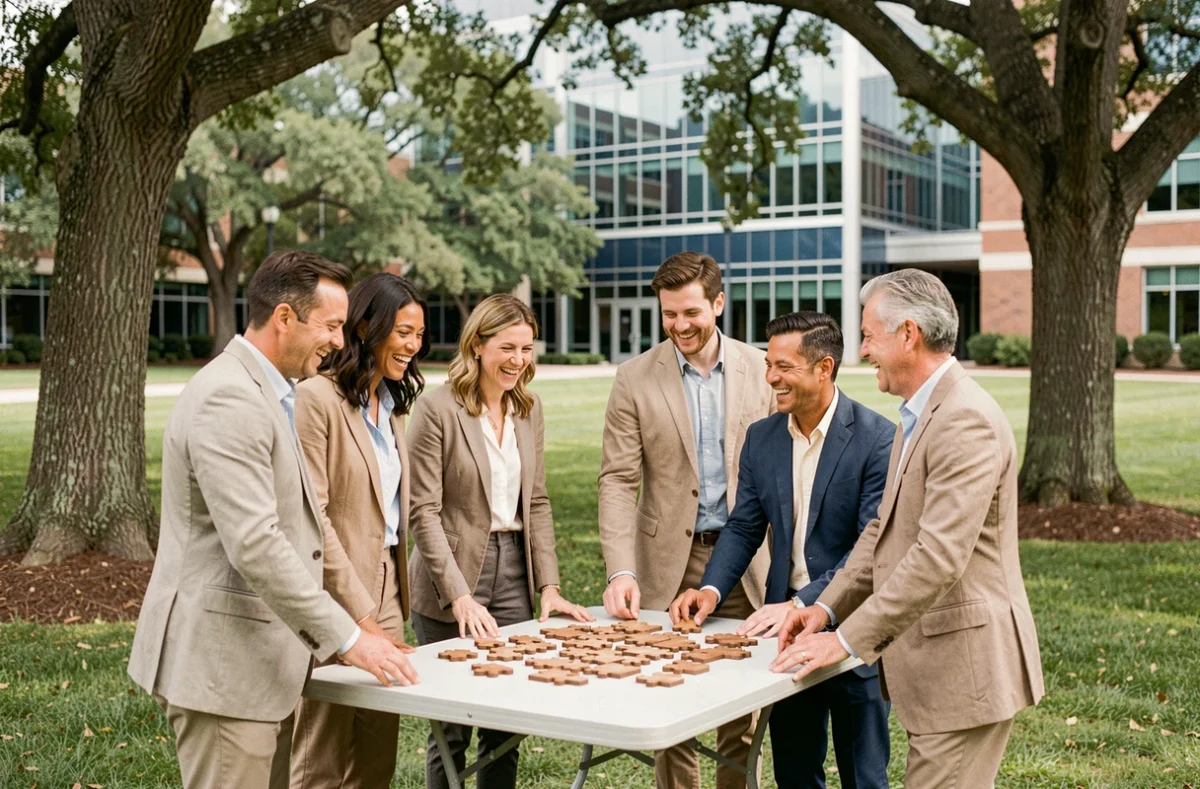
A team of eight spends three hours building a raft, laughs a lot, posts photos on the internal channel, then returns on Monday morning to the same meetings where three voices dominate the conversation. This is a scenario we see all too often.
The problem isn’t the activity itself, but what happens before and after it. Organizing a team-building day that strengthens team cohesion over the long term means working on specific behaviors, not just creating a good atmosphere.
Team cohesion: what happens before the big day
The usual temptation is to look for an activity first, then pick a date. We rarely do it the other way around. Starting with the team’s real pain points leads to better results.
Before booking anything, you can ask employees three simple questions: What gets in the way of collaboration in your day-to-day work? Which group activities work well? And what does everyone avoid saying in meetings? The answers will guide your choice of activity far more effectively than a catalog of ideas.
If the specific issue is an imbalance in who gets to speak, choose a format where roles rotate (solving puzzles or working on a group build with a different person leading each stage). If the problem is a lack of connection between sub-teams that never interact, mixing up the usual groups should be the priority, not the type of activity.
Organizing a team-building orienteering race is a good example of this approach: participants have to communicate continuously, divide up navigation tasks, and make quick decisions together, putting behaviors into practice that can be directly applied at work.
Team-building activities: choose what gets people practicing, not just having fun

An escape room, a cooking workshop, an outdoor race: all these activities can strengthen team cohesion—or change nothing at all. The difference comes down to a factor that activity catalogs rarely mention: does the activity give the team a chance to practice a specific collaborative behavior they haven’t mastered yet?
A study published in BMJ Quality & Safety examined the effects of structured debriefings in hospitals. The researchers observed improvements in psychological safety and inclusion after sessions where participants explicitly learned to listen to one another, give everyone a chance to speak, and discuss challenges. The hospital setting differs from that of a typical company, but the same principle applies: how people work together matters more than the setting.
When choosing an activity for your employees, you can check three things:
- Does the activity require genuine interdependence (does each participant have information or a skill the others don’t)?
- Do roles change along the way, or do the usual leaders stay in control from start to finish?
- Is time set aside for a debrief, or does the activity end as soon as the final result is reached?
If the answer to all three questions is yes, the activity is likely to create more than just a good memory.
Accessible venues and activities: a prerequisite for participation
Accessibility is often treated as a logistical detail to sort out at the end. In practice, failing to check accessibility means excluding some employees from the very event meant to bring them together.
Before confirming a venue, ask to see its accessibility register. Check the entire route: parking, entrance, activity spaces, and restrooms. For outdoor activities, make sure the terrain is accessible to all participants, including those who use wheelchairs or have limited mobility.
Hybrid teams present an additional challenge. Employees who work remotely most of the time don’t share the same informal connections as those who are on-site. Designing the day as an opportunity to reconnect—by making real space for informal conversations and for people who are less often physically present to speak—can change the dynamic.
A simple ten-minute icebreaker where each participant shares something about their workday that others don’t usually see can sometimes be enough to restore balance.
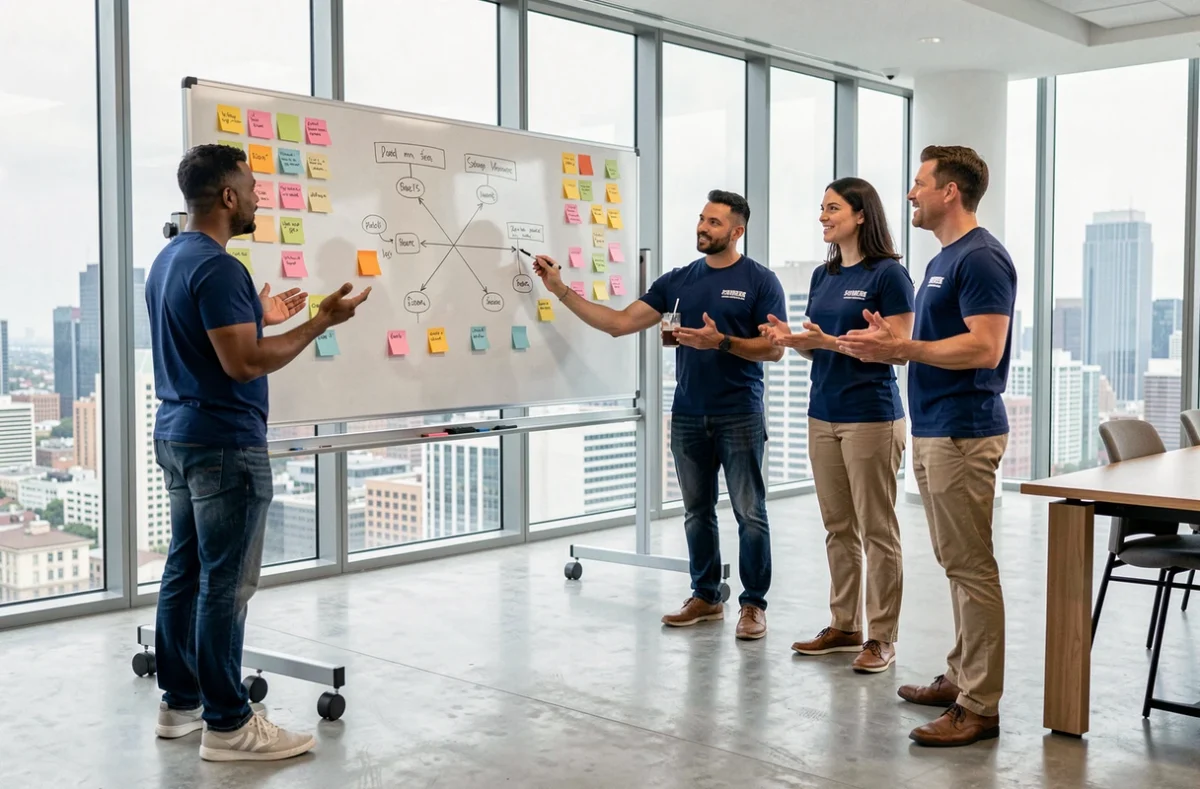
Follow-up after team building: what makes team cohesion last beyond the day
A systematic review of studies published between 1999 and 2018 analyzed team development interventions, including problem-solving and role clarification. It found effects on certain team dynamics, particularly psychological safety. It also noted that evaluations often rely solely on participants’ self-reports, and that more objective measures are needed.
In practice, this means that a satisfaction survey sent out that same evening isn’t enough to measure the impact. In the weeks that follow, you can look for concrete signs:
- Are people speaking up more evenly in meetings than before?
- Are disagreements being raised earlier in projects instead of erupting at delivery?
- Are everyone’s roles clearer to the rest of the team?
Scheduling a follow-up two to three weeks after the event makes it possible to check whether the commitments made during the debrief are reflected in day-to-day work. It doesn’t need to take long: half an hour in a team meeting, with an open-ended question about what has changed and what hasn’t.
How long the effects last depends on the size of the team, the type of activity, and, above all, the support managers provide in the days that follow. A team whose manager explicitly revisits the commitments made during the debrief is more likely to maintain its progress than one left to its own devices after the event.
The real measure of a successful team-building day isn’t how happy participants look at the end, but what changes in their interactions three weeks later. Plan the day around the behaviors you want to develop, choose an activity that puts them into practice, then follow up: this three-part approach turns team building from a pleasant break into a lasting driver of team cohesion.